Superficial WM
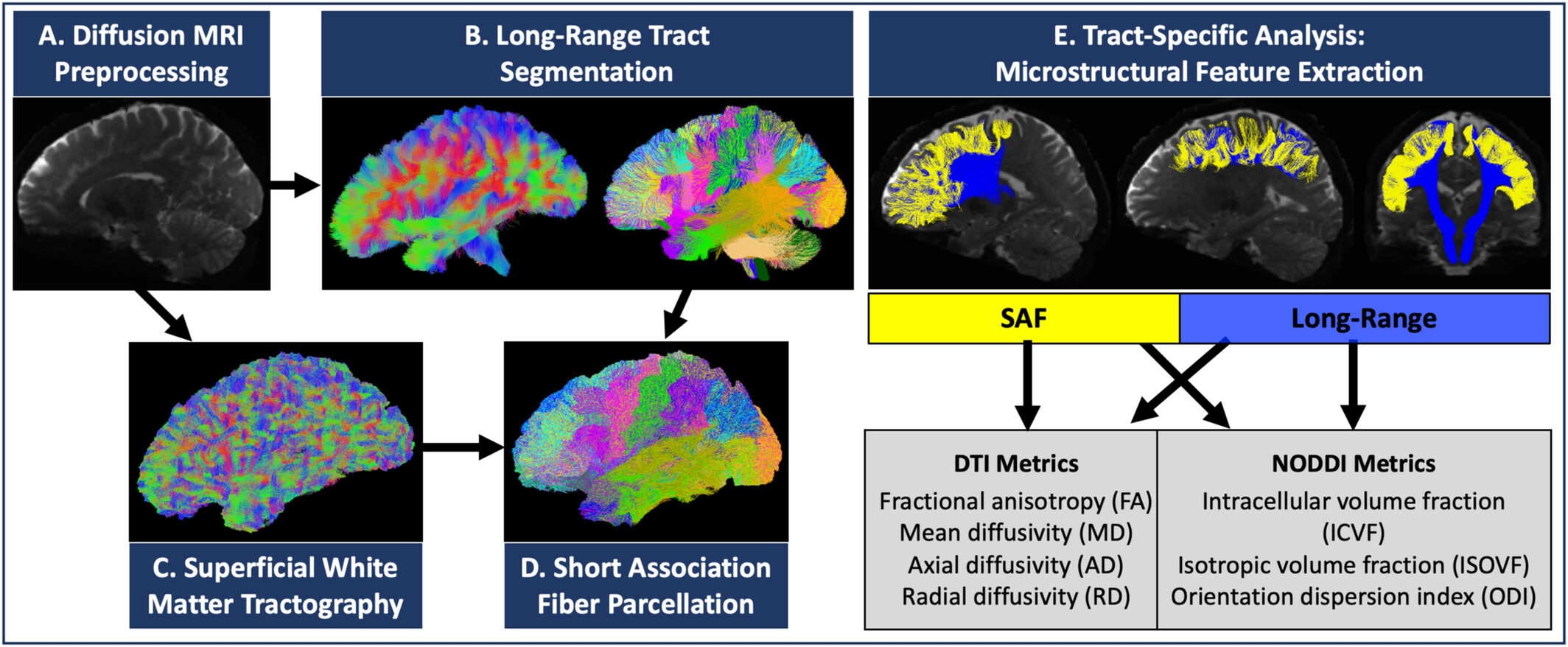
Lobar short association fiber tractography and diffusion metric summaries from diffusion MRI
The superficial white matter (SWM) pipeline processes diffusion MRI to generate superficial white matter tractography, lobar short association fiber (SAF) bundles, and diffusion metric summaries. It ships as a single Singularity/Apptainer container — superficial_WM.sif — hosted on Zenodo.
Derived inputs that are not supplied are generated automatically: without FreeSurfer outputs the container runs FreeSurfer reconstruction on a T1-weighted image from the inputs, and without FA/MD/AD/RD maps it computes them with MRtrix. Fiber-wise free-water metrics can be provided to include those measurements in the summaries.
Usage
Place the data in a directory named test_input with exactly these names:
test_input/
├── dwmri.nii.gz
├── dwmri.bval
├── dwmri.bvec
├── mask.nii.gz
├── orig.mgz                     # FreeSurfer outputs (else run from a T1)
├── aseg.mgz
├── brain.mgz
├── aparc.a2009s+aseg.mgz
├── aparc+aseg.mgz
└── metrics/
    ├── dwmri%fa.nii.gz          # DTI maps (else computed with MRtrix)
    ├── dwmri%md.nii.gz
    ├── dwmri%ad.nii.gz
    ├── dwmri%rd.nii.gz
    └── freewater_single*.nii.gz # fiber-wise free-water metrics (optional)
The diffusion data should already be preprocessed — the pipeline performs no motion, eddy-current, or susceptibility-distortion correction — and any supplied metric maps must be aligned in physical space to the diffusion data. If FreeSurfer needs to be run, pass a license file by adding -B /absolute/path/to/license.txt:/opt/freesurfer/license.txt:ro before the image name (replace singularity with apptainer where appropriate).
With superficial_WM.sif alongside test_input:
mkdir -p test_output test_tmp
set -o pipefail

singularity run -e -c \
  -B "$(pwd)/test_input:/INPUT" \
  -B "$(pwd)/test_output:/OUTPUT" \
  -B "$(pwd)/test_tmp:/tmp" \
  --home /tmp \
  superficial_WM.sif 2>&1 | tee swm_run.log
Use separate output and temporary directories for each subject and run — the pipeline copies inputs into the output directory and starts all stages again on each invocation — and retain swm_run.log with the results. Full requirements, input details, and current limitations are documented in the Zenodo record.
Outputs
Results are written to test_output/: lobar SAF tractograms (SAF_lobes/*_OR.tck), per-bundle track-density images (SAF_lobes_TDI/*_TDI.nii.gz), binary bundle masks (SAF_lobes_mask/*_mask.nii.gz), and per-bundle, per-map metric summaries (ALL_Metrics_JSON/*.json), together with the whole-tractogram tracks_2mio.tck, U_density_1mm.nii.gz, b0.nii.gz, connectome.csv, and assignments.txt. Bundle names use the eight lobar groups F, FP, O, PO, P, PT, T, and OT (frontal, frontoparietal, occipital, parieto-occipital, parietal, parietotemporal, temporal, and occipitotemporal), each split by hemisphere (L/R), for 16 requested bundle groups. The tractogram uses 2,000,000 streamlines with a minimum length of 5 mm and a maximum length of 40 mm.
Chloe Cho, Maxime Chamberland, Francois Rheault, Daniel Moyer, Bennett A. Landman, and Kurt G. Schilling. “Microstructural Characterization of Short Association Fibers Related to Long-Range White Matter Tracts in Normative Development” Human Brain Mapping, 46.8 (2025): e70255. Container: Zenodo, 2026.