
BRAID
Brain age identification from diffusion MRI
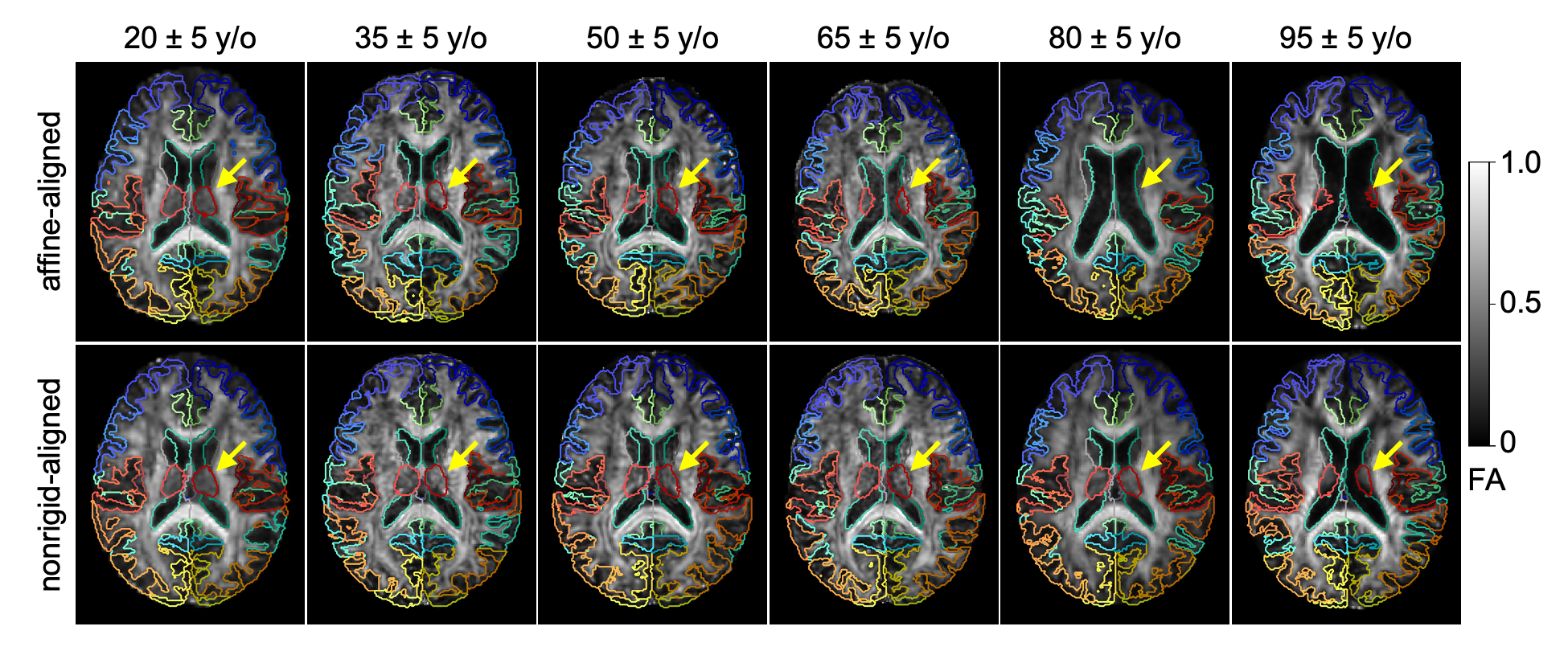
BRAID estimates brain age from diffusion MRI. Unlike its counterparts, which typically use anatomical features (such as volume and shape of brain regions), BRAID deliberately destroys anatomical information through non-rigid transformations so it can focus on subtle microstructural changes that predate apparent anatomical changes in neurodegeneration. The goal is not a perfect chronological age estimator, but an earlier biomarker for neurodegenerative disease prediction.
Usage
A pre-built Singularity container is available on Zenodo (DOI: 10.5281/zenodo.15091613); all dependencies are pre-installed inside the container. Provide an INPUTS folder containing dwmri.nii.gz, dwmri.bval, dwmri.bvec (PreQual-preprocessed), T1w.nii.gz, T1w_seg.nii.gz (brain mask), and demog.json (demographic information), then:
singularity run -e --contain \
    -B /path/to/INPUTS:/INPUTS \
    -B /path/to/OUTPUTS:/OUTPUTS \
    -B /tmp:/tmp \
    /path/to/braid_v1.0.0.sif
Expected runtime is about 3 hours. The outputs appear in the final folder of OUTPUTS: braid_predictions.csv (brain age estimates by model, before and after bias correction) and QA.png (visualization of the brain images and estimates). A worked example with sample data is included in the Zenodo record. Alternatively, the source code can be run from the repository (Python 3.11+; model weights on Hugging Face).
Chenyu Gao, Michael E. Kim, Karthik Ramadass, Praitayini Kanakaraj, Aravind R. Krishnan, Adam M. Saunders, et al. “Brain age identification from diffusion MRI synergistically predicts neurodegenerative disease” Imaging Neuroscience, 2025.
Chenyu Gao, et al. “Predicting age from white matter diffusivity with residual learning” In Medical Imaging 2024: Image Processing. International Society for Optics and Photonics, 2024. https://doi.org/10.1117/12.3006525.