
MidRISH
Cross-site harmonization of diffusion MRI via rotationally invariant harmonics
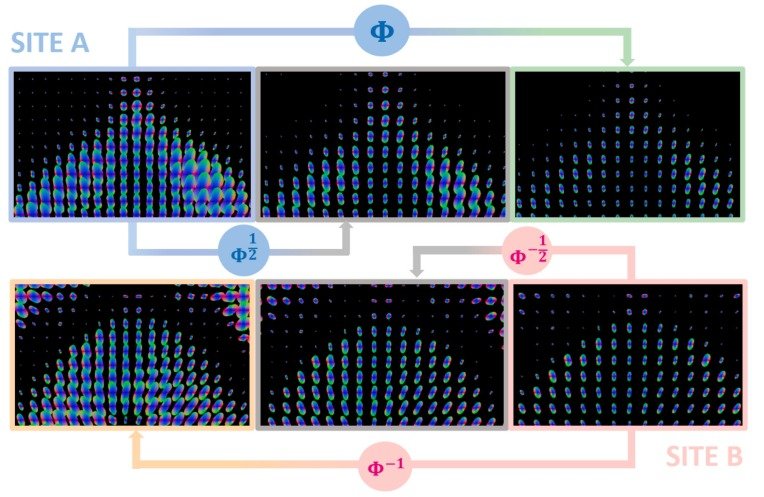
MidRISH harmonizes multi-shell diffusion MRI across sites using rotationally invariant spherical harmonics (RISH). In two stages, it first creates a population template: the signal is modeled as a spherical harmonic representation (the user sets the maximum order), the rotationally invariant harmonics are computed, the RISH features are registered to MNI space (e.g., with FSL epi_reg or ANTs), and a template combining all RISH features is computed. The template is then applied to harmonize new data, producing a reconstructed signal function and a fitted tensor model.
Usage
The code is a set of Python and shell scripts with the following dependencies: MRtrix, ScilPy, Python 3.8, FSL, and FSL FLIRT. See the repository for the full walkthrough (template creation with Get_RISH_Features.py and Compute_Template.py, and template application with Apply_Template_to_DWI.sh).
Note that RISH works best when the input data are projected to the same b-value; the reference data fall within 500 < b < 1500, and large b-value jumps are not supported at this time.
Nancy R. Newlin, Michael E. Kim, Praitayini Kanakaraj, Tianyuan Yao, Timothy J. Hohman, Kurt Pechman, Lori L. Beason-Held, Susan M. Resnick, Derek B. Archer, Angela L. Jefferson, Bennett A. Landman, and Daniel M. Moyer. “MidRISH: Unbiased harmonization of rotationally invariant harmonics of the diffusion signal” Magnetic Resonance Imaging, 2024 (preprint: bioRxiv, 2023).